Rowing (FTMS): Muscles Worked, Technique, and Lower-Back Safety.
Rowing works 85% of your muscles. Discover the ideal technique and avoid back injuries.
Master the Rowing Machine (FTMS): Muscles Worked, Technique, and Lower-Back Safety
The rowing machine (FTMS) is often hailed as the ultimate "full-body" exercise, and with good reason. Unlike many machines that isolate a single muscle group, rowing demands a synergistic coordination that engages nearly 85% of your muscles.
Understanding which muscles you work and at what moment is vital. A balanced, pain-free workout depends on each muscle group doing its job in the correct sequence, with the safety of your spine as our top priority.
The Key Muscles: A Phase-by-Phase Analysis of Force
Rowing involves three major muscle groups acting in perfect sequence:
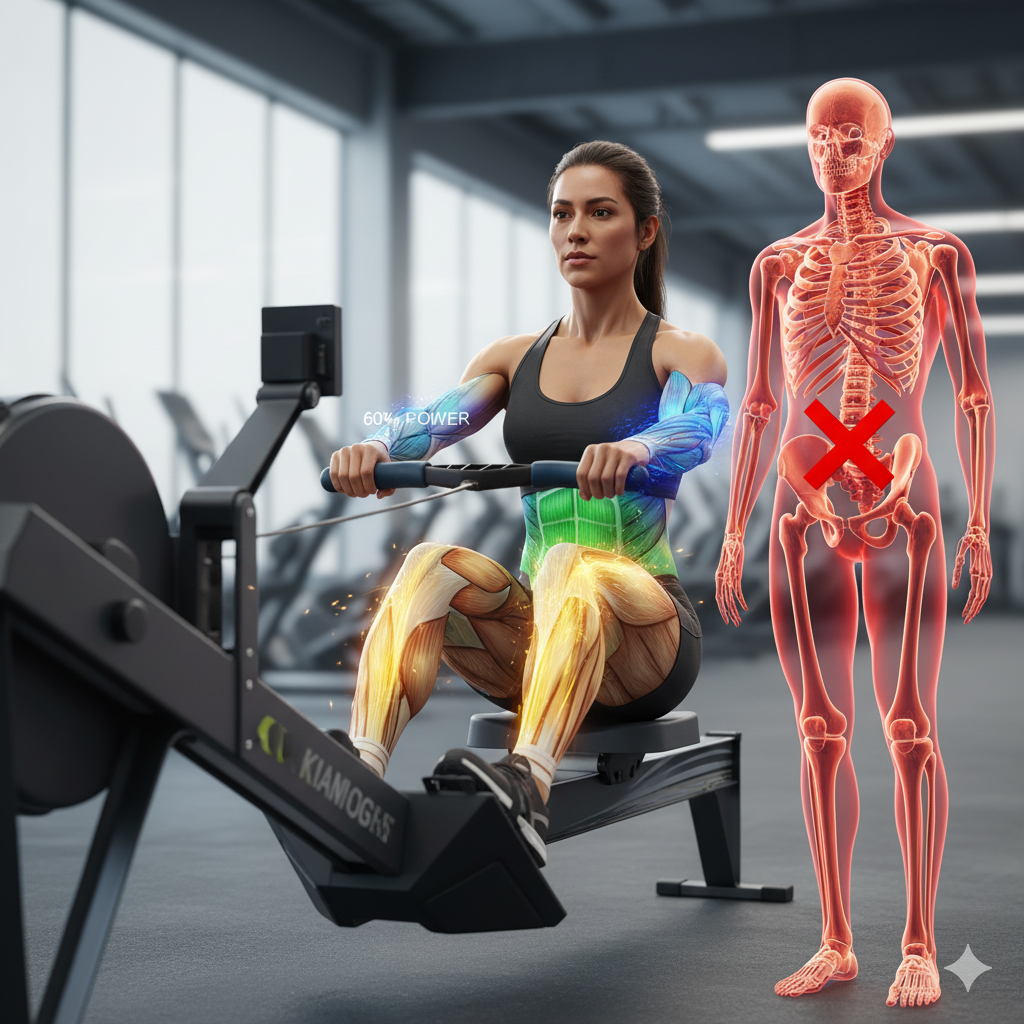
1. The Driving Force: The Lower Body (60% of the Power)
This is the initial phase (the Drive) and the most powerful one. If you do not use your legs properly, you overload your back.
- Glutes (Gluteus Maximus and Medius): The main engine, responsible for hip extension.
- Quadriceps: They drive knee extension, pushing you away from the flywheel.
- Hamstrings and Calves: Crucial at the end of the drive and during the controlled Recovery phase.
2. The Protective Shield: The Core and Trunk
Your core is your power center. Its main job is to stabilize and transfer force, not to generate movement.
- Abdominals (Transverse, Rectus, and Obliques): They keep the spine in a neutral position, preventing your back from rounding.
- Spinal Erectors: They work isometrically to maintain the stability of the spine.
3. The Finishers: The Back and Upper Body
These muscles are key at the end of the drive and for posture.
- Latissimus Dorsi and Rhomboids: The large back muscles are in charge of pulling the elbows back.
- Trapezius (Middle/Lower): They stabilize the shoulder blades, preventing tension in the neck and shoulders.
- Biceps and Forearms: They act as the final link, bringing the handle to your body.
Indications and Precautions: Is Rowing Right for Me?
Although the rowing machine is low impact, performing the movement requires specific ranges of motion.
✅ People who CAN use the FTMS Rower (with correct technique):
- Healthy Individuals: Ideal for anyone looking for a comprehensive cardiovascular and strength workout.
- Low Joint Impact: Excellent for protecting the knees and ankles, making it an alternative to high-impact exercises such as running.
- Controlled Recovery: With resistance adjustments, it is a great tool for regaining functional strength in the trunk and limbs.
🛑 People who should NOT use the Rower, or who require a physical therapy assessment:
- Acute or Recent Low-Back Pain: The repetitive flexion-extension movement (however subtle) can be counterproductive and worsen the pain.
- Diagnosed Herniated Disc: Incorrect technique can increase pressure on the disc. Approval and guidance from a physical therapist are essential.
- Active Limb Injuries: Conditions such as severe elbow tendinitis (epicondylitis) or carpal tunnel syndrome can be aggravated by the grip and the pull.
- Severely Limited Mobility: If stiffness in your hip or ankle prevents you from sitting with a straight back in the starting position, the risk of a lower-back injury is very high.
Physical Therapy: Your Ally for Safe, Powerful Rowing
At Fisioterapia en Colombia, we do not just treat rowing injuries; we prevent them. If you cannot keep your back straight, or you feel that pain is limiting your training, the problem is usually a muscle imbalance or joint stiffness.
We offer you:
- Biomechanical Assessment: We identify which muscles are weak (e.g., your core or glutes) and which are stiff (e.g., your hamstrings), standing in the way of your perfect technique.
- Targeted Rehabilitation: We give you strengthening and mobility exercises to restore your safe range of motion, ensuring that 60% of your power comes from where it should: your legs.
Do not let muscle weakness or poor technique sabotage your training. Your rowing machine should make you stronger, not injure you.
👉 Book your assessment at Fisioterapia en Colombia today to make sure every stroke is efficient, safe, and brings you closer to your health goals without an injury setting you back.
Do these symptoms sound familiar? Book your evaluation.
Book via WhatsApp